Wednesday, April 25, 2018

This Teacher Works the Right AND Left Side of Your Brain

I am probably one of the least creative people you’ll ever meet. I am constantly on Twitter or reaching
out to the people I work with to get new ideas of how to integrate technology into the classroom. And I
am without a doubt the least artistic person you’ll ever come across. I hated Thursdays when I was
little because that was arts and crafts day at my elementary school. But I think my view on arts and
crafts would be totally different if I had Barbara Kennerly as my art teacher back in the day. The entire
right side of my brain would be way more developed if “Mrs. K” had been around in my younger days.
I have had the pleasure of working with Barb for a couple of years now and in my opinion, she is one
of the best art teachers we have in our district. She expands the cultural awareness of her students
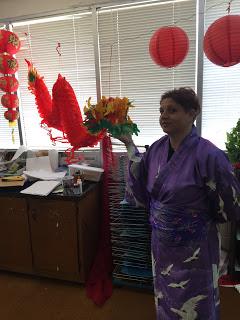
tenfold from what they’ve had prior to walking in her classroom. She’ll even wear the clothing that
goes along with her lesson, which makes her even more special for her students. Here she is wearing
a Japanese kimono to go along with the lesson I'm highlighting:
She knows her curriculum like the back of her hand but it doesn’t stop there. She reaches beyond
the art program to make connections to what’s going on in the other areas of instruction. One of my
favorite projects that I helped out with this year was a collaboration with Mrs. K where she integrated
art, science and technology into the 5th grade literacy curriculum. Her students created a dragon
tooth that we then 3D printed for them!


I took a wild ride into Barb’s head to pick her brain about this assignment and get all the details. Here’s
what she had to say about this amazing lesson. Buckle up...
“It started with Dana Wyckoff (the 5th grade ELA teacher), she was doing a story Where the Mountain
Meets the Moon. I was integrating the Chinese New Year and how the dragon is used as a symbol in
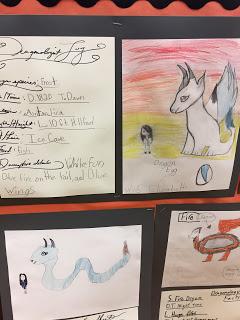
more than one culture. Then the assignment was that we were going to be dragon scientists and we
discovered a new dragon. We logged all the scientific information into our notebook (where it lives,
what it eats, its environment and how it would influence its color, antarctic dragon would be white or
blue, etc.) In this project they designed the tooth that went with the dragon. The shape of the tooth
would indicate whether it was a carnivore or not. This was also connected to the Dragonology books
that students were working with in the media center.
Barb is going to take the dragon teeth that we 3D printed and turn them into a necklace that students
can wear! Almost like those shark tooth necklaces that you get at the beach. The students at Cameron
Elementary and Southern Pines Primary are very fortunate to have Mrs. K as their art teacher. I’m so
jealous of those Scots and Bees. They get to have an offbeat, inspirational, funny (in a good way)
and creative art teacher to open their eyes to the wonderful world of art.

-Clint

Wednesday, March 28, 2018

4th Annual Digital Learning Showcase!

On March 15th, 2018, Moore County Schools put on our 4th Annual Digital Learning Showcase at Vass-Lakeview Elementary.  It's hard to believe just how far we have come since our first showcase at Union Pines High School in 2014.


Once again, our students, teachers, and DIFs stepped up and showed how they use digital tools in their classrooms to collaborate, communicate, think critically, and create.  Below are just some of the examples from the night:


Students shared how they:

  • collaborated across the globe to create 3D printed flashlights
  • used Dash the robot to study black history month
  • learned about cyber security through Cyber Patriot
  • utilized virtual reality to connect to amazing environments way outside Moore County
  • built and programmed advanced robotics
  • used green screen technology connected to their reader's theater
  • used 3D printing to design and print ancient structures in HS social studies
  • coded circuits with Arduino
  • And so much more!!!
However, one of the most exciting parts of our showcases each year is how the kids get a chance to visit and learn from other students throughout the night.  It is so rewarding to see our students being exposed to all the wonderful possibilities that technology and digital learning can bring!


Thanks to all who came!  We look forward to seeing you again next year!


Tuesday, February 20, 2018

Curricular Coding Infusion


According to Emily Hayden, "Learning code requires thinking and encourages curiosity" (2016). It is a form of engineering with planning, problem solving, and tons of trial and error.   Coding even offers that "gaming" or "level up" feeling when the finished product executes correctly.  Teachers will often hear those delightful words shouted aloud -"I got it!" and "It works!"  

Additionally, "Computer-related jobs are expected to grow at the faster-than-average rate of 12 percent through 2024, according to the Bureau of Labor Statistics (BLS). The BLS also reports that the median annual salary for these professionals in 2015 was $81,430, which was more than two times the average for all occupations.  This figure has been increasing!

So, how do we make coding more accessible to students?

The answer is by infusing the curriculum with coding!

Mr. Thomas' 7th grade math students, at Crain's Creek Middle School, enjoyed putting their knowledge of complimentary and supplementary angles to the test today while infusing a little Python Coding.  The programming even progressed to include a little introduction to artificial intelligence! 


Using the website Trinket, students started with a basic code, which drew a 90 degree angle.  

This was the code:

from turtle import *

turtle1 = Turtle( )

turtle1.forward(100)
turtle1.left(90)
turtle1.forward(100)


Then, they were asked to write a program, which drew a 40 degree angle.

Students tried different coding combinations.  The first thought was to simply change the 90 to a 40.  Using the Desmos Angles Site in conjunction with their coding attempts, they soon discovered that this did not work.  Students realized that they needed to think of their initial line as 180 degrees 
(a straight line).

Students' hands flew in the air as they realized many different iterations, which achieved the desired outcome.

Some examples included:


from turtle import *

turtle1 = Turtle( )

turtle1.forward(100)
turtle1.left(140)
turtle1.forward(100)

from turtle import *

turtle1 = Turtle( )

turtle1.forward(100)
turtle1.left(180-40)
turtle1.forward(100)

from turtle import *
turtle1 = Turtle( )
turtle1.backward(100)
turtle1.left(40)
turtle1.forward(100)

Then, students experimented with a "magic function machine" code, which allowed them to choose any angle they wanted and the computer would draw it automatically.

Students realize that functions in coding made the code easier and involved less typing!

This is the start to understanding abstraction - 
a very important term in computer science!


Finally, students experimented with a little "artificial intelligence."

If you would like to test out this code, please click HERE and have fun!

Happy Coding!


Thursday, February 15, 2018

Google Comes to Town


There was a buzz in the air at New Century Middle School on Thursday, February 15th.  Some might think students were still jittery from a candy-heart sugar high.  While that may have had a little to do with it, the real show was in Mr. Clothier's Art classroom.  Dr. Susan Jinks, a Career and Technical Education teacher at New Century, signed up for a demonstration of the Google Expedition Pioneer Program.  Students were able to check out the latest in Augmented Reality using Asus Zenfone devices attached to selfie-sticks.


What is Augmented Reality?  If you have ever used a Snapchat filter to put Puppy ears on your profile picture, you have used Augmented Reality(AR).  AR uses live digital images layered over your view of the real world.  In the picture below, students were viewing the inner planets (Mercury, Venus, Earth and Mars) through the camera on the device.


The different tours visited today included Forces of Nature, The Solar System, Ancient Rome, Ecosystem of a Coral Reef, World War I, DNA and RNA.  Students were able to navigate all angles of objects that were super-imposed on their view of the classroom.  Some students even went as far as getting on the floor to see the underside of objects.  Below, two students tried to get a better view of the underside of an octopus from the Coral Reef Ecosystem tour.


The video below is from Google's YouTube page and shows what the kids today were able to experience.  Google Expeditions is a great way for teachers to bring the world into the classroom and expose students to things they may not have a chance to experience otherwise.  


The Google Expedition Pioneer app is still in Beta so it is not available in app stores.  A list of the available tours can be found here.


If you are interested in bringing this type of experience to your school, sign up here.

Tyler Callahan
@STEM_TC
jcallahan@ncmcs.org

Wednesday, February 14, 2018

The Elementary DIF's take a trip to the Virginia Children's Engineering Convention

   A week ago the elementary Digital Integration Facilitators (DIF's) of Moore County were fortunate enough to attend the Virginia Children's Engineering Convention (VCEC) in Roanoke, Virginia. The conference celebrated the innovative ideas in regards to STEM and offered a variety of sessions on tools to use in the engineering classroom. We gathered many new resources and various ideas on how to better integrate STEM education into the everyday classroom.


   In Moore County, we are already doing a lot of STEM practices and education in the K-12 classroom. We have developed an engineering thread that perfectly aligns with teachers' pacing guides K-8, and many teachers appreciate the impact this type of learning has on their students. Many of the K-5 educators in Moore County, have branched out to seek other STEM activities to do with their students. As a DIF, that is what you strive for! We want our teachers to be vested in this type of learning, see the value, and start adopting these practices on their own. 


On May 4, beginning teachers will have an opportunity to visit our robotics showcase at Pinecrest High School and see STEM education at its finest. In addition, we also will host a digital learning showcase at Vass-Lakeview Elementary School on March 15 from 6-7:30pm. It is because of terrific conferences such as the VCEC that Moore County continues to pave the way for STEM education. I know the DIF's are eager to try out their newly acquired material from the conference and share with their fellow teachers.


~Deanna Boesch

What STEM education looks like in Mrs. DeMestre's 5th Grade Class

   STEM education and engineering are a growing area for elementary classrooms. Many schools and districts across the United States are adopting a STEM program and are encouraging the development of STEM skills. At Pinehurst Elementary School, in Moore County, Mrs. DeMestre is a 5th grade teacher that has fully adopted the use of STEM education! She uses STEM/engineering to enhance her students' understanding of various concepts. If you are wanting to adopt a STEM program in your classroom, check out the responses of Mrs. DeMestre and her students.
   Introducing the engineering design process and letting your kids learn through play and experimentation can be scary at first. It is an entirely different approach to teaching. Below are some responses from Mrs. DeMestre and her students on how they handle this challenge!


1.) What does STEM/Engineering in your classroom look like?
"Chaos... in the absolute best sense of the word! Among the inevitable clutter of supplies and building materials, it looks like collaboration and critical thinking at its finest. Students are engaged in small group conversations aimed at tackling challenges and finding creative solutions." 

2.) What do you and your kids like most about STEM/Engineering in the classroom?
"What I love most about STEM in our classroom is the innovation. I am always impressed by the variety of approaches to reach a common goal." 
   
   Even though there are the inevitable challenges that come with providing this type of education in your classroom, there are also sweet rewards. Not only are students engaged and focused on the task, but STEM challenges foster the use of higher order thinking and application skills. As educators we always want our students to learn, but to enjoy the process of learning. Mrs. DeMestre's 5th graders have fully endorsed the use of STEM/engineering in their classroom. One student reports, "I love building things and being challenged." Another student says that, "STEM challenges teach us to look at a problem in a different way." "You can be creative", and "having to build on a budget because we get to do math" are only some of the many positive responses to this type of learning. 


3.) Do STEM/Engineering lessons enhance your students understanding of concepts taught? If so, how?
"STEM lessons definitely enhance students' understand of concepts taught. Each phase of the engineering process requires students to dig deeper and apply what they know. One of the most powerful aspects of the lesson is the "Improve" segment, when students are asked to make revisions for improvement." 


4.) Would you recommend to other teachers the use of STEM in their classroom? If so, why?
"Absolutely! STEM is an opportunity for failures and feats to be equally valued. In our classroom we say, "Mistakes are expected, respected, inspected and corrected." Celebrating failure is critical in our endeavor to grow risk-takers." 

5.) What is your favorite memory of a STEM/Engineering lesson in your class?
"It is impossible to choose just one favorite memory... LEGO Story Starters are always a huge hit! I love being able to incorporate STEM into our Social Studies curriculum. We use the LEGO Story Starter kits to design scenes depicting major causes of the American Revolution."

With STEM education the opportunities are endless! We are producing independent, inquiring, and critical thinking minds that will expand our future as a nation. The process can be messy and it requires an all hands on deck approach; however, your students and school with reap the benefits of providing this type of learning environment.


~Deanna Boesch